
Anna Forsythe at ESMO AI & Digital Oncology 2025

Last week, Oncoscope-AI Founder & CEO Anna Forsythe gave a podium presentation to a packed room of clinicians, researchers, and industry leaders at ESMO AI & Digital Oncology in Berlin. The subject? What Oncoscope-AI does best: Living Systematic Review Linked to Guidelines and Regulatory Approvals as a Treatment Decision Support Tool. Now you can see Anna’s full talk too: Oncoscope-AI Founder & CEO presents at ESMO AI & Digital Oncology Congress in Berlin, Germany. 12 November 2025. Oncoscope-AI: Living Systematic Review Linked to Guidelines and Regulatory Approvals as a Treatment Decision Support Tool
Systematic Literature Review Versus Chatbots: Why In Oncology, It’s Not a Choice

In the age of artificial intelligence, speed is often mistaken for rigor. Nowhere is this more dangerous than in oncology, where treatment decisions can mean the difference between life and death. Some technology companies tout “systematic literature reviews” (SLRs) generated in minutes by chatbots that claim to scan thousands of papers across the internet. The appeal is obvious: quick, accessible, and seemingly comprehensive. But in reality, these outputs are neither systematic nor reliable. For oncologists, payers, and researchers, understanding the distinction between a true SLR and a chatbot’s surface-level search is not just academic—it’s essential. The Gold Standard: What a True SLR Involves Systematic literature review is the gold standard for evidence synthesis in medicine. It is the foundation of evidence-based practice because it minimizes bias, ensures completeness, and enables decisions to rest on the strongest available science. A rigorous SLR begins with a protocol: a predefined roadmap that frames the research question and methods. It requires carefully constructed search strategies, typically using combinations of keywords and controlled vocabulary, to capture every relevant publication across peer-reviewed databases. The process doesn’t stop there. Grey literature—such as abstracts from scientific conferences—must also be included, since cutting-edge oncology data often appears in congress presentations long before it reaches a journal. From there, studies undergo multi-step screening against strict inclusion and exclusion criteria: patient population, interventions, comparators, outcomes, and study design (the classic PICO framework). Each selected paper is then critically appraised for quality and relevance. Only after this painstaking filtering does the work of synthesis and interpretation begin. This is not a clerical exercise. It requires advanced training, sound judgment, and clinical insight to evaluate conflicting results, contextualize findings, and translate them into actionable conclusions. Why Chatbots Fall Short Chatbots, even those powered by large language models (LLMs), cannot replicate this process. At best, they skim unstructured text. At worst, they hallucinate citations or omit critical studies. They lack protocols, inclusion criteria, appraisal of study quality, or a transparent audit trail. What results may look convincing on the surface—but lacks the depth and reliability required in oncology. When a chatbot says it can “review 1,000 studies in seconds,” what it’s really doing is producing a text summary based on whatever sources it happens to ingest. There is no guarantee that the sources are peer-reviewed, complete, current, or even real. That is not an SLR. Why It Matters in Oncology Oncology is not forgiving of shortcuts. Selecting the right therapy for a patient is an exercise in precision: choosing between regimens, sequencing targeted therapies, balancing efficacy and toxicity, and staying current on breakthroughs that can extend survival or improve quality of life. In this context, incomplete, outdated, or fabricated evidence isn’t a minor flaw—it’s a threat to patient safety. The rigor of a systematic literature review is not a “nice to have”; it’s the foundation for making responsible decisions in cancer care. The Path Forward AI absolutely has a role to play in evidence synthesis. When paired with human expertise and transparent methodology, it can accelerate searches, streamline screening, and reduce administrative burden. But AI must serve the process—not replace it. In oncology, the choice isn’t between a chatbot and a systematic literature review. It’s between cutting corners and saving lives. The stakes are too high for anything less than living, rigorous, and human-guided evidence. Anna Forsythe Anna Forsythe is the Founder and President of Oncoscope-AI, the first platform to bring together real-time oncology treatment data, clinical guidelines, research publications, and regulatory approvals — all in one place, just like Expedia for cancer care. Available free to oncology professionals worldwide, Oncoscope-AI is redefining how cancer care information is accessed and applied.
From Cochrane to Chatbots: Have We Forgotten the Evidence?

If medicine had a godfather of evidence, his name would be Archie. Archibald Leman Cochrane, that is. Cochrane wasn’t just a physician—he was a rebel against tradition. In the 1970s, he looked around at the medical world and said, essentially: “Too much of what we do is based on habit and authority, not actual proof.” He proposed a radical idea: let’s rank evidence by reliability. At the bottom sat case reports and expert opinions—interesting, but hardly solid. Above that came observational studies, then randomized controlled trials (RCTs). And sitting proudly at the top of the pyramid? Systematic literature reviews (SLRs): structured evaluations that capture all the studies, critique their quality, and synthesize their findings. That hierarchy became the foundation of what we now call Evidence-Based Medicine (EBM). Why Systematic Reviews Matter Systematic reviews aren’t academic busywork. They’re the reason guidelines from the World Health Organization, NICE, and the American Society of Clinical Oncology (ASCO) are trustworthy. They’re why the FDA demands comprehensive, systematic evidence before approving a therapy. The principle is simple: no single trial tells the full story, but when you put the whole picture together—carefully, transparently, reproducibly—you can make decisions that change lives. But Have We Forgotten Cochrane? Fast forward to today. AI chatbots can answer clinical questions in seconds. They sound authoritative, but they don’t follow Cochrane’s hierarchy. They don’t systematically review literature. They don’t grade evidence for quality. And they definitely don’t show their work. In oncology, where new studies are published daily, this is not a minor issue. A chatbot that casually cites one study—or worse, invents a citation—could mislead a physician into recommending something harmful, or missing a life-saving option. It’s like we built the evidence pyramid over decades, and now, dazzled by shiny AI, we’re forgetting why we built it in the first place. The Way Forward The future of evidence isn’t abandoning systematic reviews. It’s making them living: constantly updated, rigorous, and transparent. AI does have a role to play here—not as a chatbot dispensing unverified answers, but as a tool that accelerates and augments systematic reviews. That’s exactly what we’re building at Oncoscope: living SLRs, human-vetted and PhD-curated, augmented by AI. Reliable, current, and ready to support the most important decisions in oncology. Because in cancer care, evidence isn’t an academic debate. It’s a matter of life, harm, or hope. So the question is: are we going to let chatbots distract us from Cochrane’s lesson—or use AI to fulfill it? Anna Forsythe is the Founder and President of Oncoscope-AI, the first platform to bring together real-time oncology treatment data, clinical guidelines, research publications, and regulatory approvals — all in one place, just like Expedia for cancer care. Available free to oncology professionals worldwide, Oncoscope-AI is redefining how cancer care information is accessed and applied. A clinically trained Doctor of Pharmacy (PharmD), Anna also holds a Master’s in Health Economics and Policy from the University of Birmingham (UK) and an MBA from Columbia University. She previously co-founded Purple Squirrel Economics (acquired by Cytel in 2020) and led Global Value and Access at Eisai Pharmaceuticals, following earlier roles at Novartis and Bayer in clinical research and health economics.
America’s AI Action Plan & Implications for AI-Powered Clinical Support Tools

As federal AI policy takes shape, it’s clear that healthcare innovation is entering a new era — one that demands both technical progress and public trust. The White House’s latest AI Action Plan pushes for national standards, clinical validation, and regulatory sandboxes to accelerate the safe, responsible use of AI in healthcare. It also warns that tools deployed without transparency, oversight, or clinical grounding may face new scrutiny — especially as states begin passing their own health AI laws. What is in the policy changes? The White House recently unveiled its “AI Action Plan,” which includes plans to tie federal AI funding access to a state’s regulatory position, potentially negatively impacting states that impose what the administration deems “burdensome” AI regulations. Another thrust of the plan is to establish regulatory sandboxes (AI Centers of Excellence), backed by NIST*-led health AI standards. These initiatives are framed around speeding up AI innovation—especially in healthcare and drug discovery. * National Institute of Standards and Technology Why does this matter for AI-powered Clinical Support Tools (CST) in Oncology? What should providers of AI-powered medical tools do? AI in healthcare is not just a tech problem — it’s a policy, workflow, and trust challenge. This legislation underscores how critical it is to be proactive at the intersection of innovation, transparency, and ethical design. I would love to hear from other founders or clinicians navigating this space—how are you approaching regulation and federal‑state interplay? Anna Forsythe is the Founder and President of Oncoscope-AI, the first platform to bring together real-time oncology treatment data, clinical guidelines, research publications, and regulatory approvals — all in one place, just like Expedia for cancer care. Available free to oncology professionals worldwide, Oncoscope-AI is redefining how cancer care information is accessed and applied. A clinically trained Doctor of Pharmacy (PharmD), Anna also holds a Master’s in Health Economics and Policy from the University of Birmingham (UK) and an MBA from Columbia University. She previously co-founded Purple Squirrel Economics (acquired by Cytel in 2020) and led Global Value and Access at Eisai Pharmaceuticals, following earlier roles at Novartis and Bayer in clinical research and health economics.
Why an AI Chatbot Can’t Replace a Systematic Literature Review — and What It Can Do

In a world where AI is evolving rapidly, one question keeps coming up in healthcare, especially in evidence generation and market access: “Can an AI chatbot replace a systematic literature review (SLR)?” As the founder of Oncoscope-AI, a platform focused on transforming how we track and synthesize oncology evidence, my answer is simple: No — not even close. But there’s a much more important follow-up: AI can fundamentally transform how SLRs are built, maintained, and used — if we apply it the right way. Why SLRs Are Still the Gold Standard Systematic literature reviews are foundational tools in evidence-based medicine. They are methodologically rigorous, reproducible, and transparent — all critical features when informing high-stakes decisions in drug development, health technology assessments (HTAs), clinical guidelines, and reimbursement. A well-conducted SLR isn’t just a literature search. It’s a structured, protocol-driven process governed by frameworks like PRISMA, Cochrane, or GRADE. It includes clear inclusion/exclusion criteria, detailed documentation of search strategies, dual reviewer consensus, and often a meta-analysis. In short: SLRs build trust — because the process is as important as the outcome. Where AI Chatbots Fall Short While chatbots like ChatGPT, OpenEvidence, Perplexity, or other LLM-based tools can sound authoritative and answer questions quickly, they have significant limitations when it comes to replacing SLRs. These characteristics make them fundamentally incompatible with the standards required in clinical research, regulatory decision-making, or payer engagement. What AI Can Do for Evidence Synthesis While chatbots can’t replace SLRs, AI can absolutely enhance the way SLRs are performed, maintained, and consumed. This is the space we are focused on at Oncoscope-AI. Here’s how: 1. Real-Time Monitoring of New EvidenceAI can continuously scan new publications, clinical trial databases, regulatory announcements, and guideline updates — surfacing relevant changes in near real-time. 2. Efficient Screening and CategorizationAI can rapidly identify and classify articles based on criteria defined in a protocol, dramatically reducing the manual burden on human reviewers. At Oncoscope, we trained and validated AI programs to deliver over 99% accuracy for this task – with details on rejections well beyond what humans are used to provide. 3. Smarter Data ExtractionWhile AI can’t yet extract all types of data reliably, there are many variables where it already performs as well as — or even better than — humans. At Oncoscope, we carefully evaluate each type of data we need to extract, and we implement AI selectively and responsibly. The rule of thumb we follow is: if you can standardize it, you can automate it. Structured variables can often be automated — freeing our experts to focus on the more complex and nuanced interpretation. 4. Version Control and Living UpdatesTraditional SLRs are static snapshots. At Oncoscope, we’re enabling “Living SLRs” — always current, always linked to their sources, and always grounded in rigorous methods. 5. Actionable Summaries Without Compromising RigorUsing AI for extraction and summarization doesn’t mean cutting corners. It means scaling expertise, speeding updates, and freeing time for deeper interpretation. Our Vision at Oncoscope-AI We are not building another chatbot. We are building an evidence engine that understands how oncology evolves — one that stays current without sacrificing standards. Our platform continuously tracks: All of this is structured, sourced, and updated in real time — providing oncologists and other healthcare professionals with a living map of the oncology evidence landscape. In short, we’re bringing the structure of an SLR and the speed of AI together — without compromising either. Final Thoughts So, can an AI chatbot replace a systematic literature review? No — and it shouldn’t. But AI, when designed for evidence integrity and real-world utility, can transform what an SLR can become. This transformation is no longer hypothetical. It’s happening now — and we’re proud to be leading it at Oncoscope-AI. Interested in how a Living SLR can support your work in oncology or market access? Let’s connect.📩 info@oncoscope-ai.com | LinkedIn Anna Forsythe is the Founder and President of Oncoscope-AI, the first platform to bring together real-time oncology treatment data, clinical guidelines, research publications, and regulatory approvals — all in one place, just like Expedia for cancer care. Available free to oncology professionals worldwide, Oncoscope-AI is redefining how cancer care information is accessed and applied. A clinically trained Doctor of Pharmacy (PharmD), Anna also holds a Master’s in Health Economics and Policy from the University of Birmingham (UK) and an MBA from Columbia University. She previously co-founded Purple Squirrel Economics (acquired by Cytel in 2020) and led Global Value and Access at Eisai Pharmaceuticals, following earlier roles at Novartis and Bayer in clinical research and health economics.
Founder Spotlight: Anna Forsythe, PharmD — Bringing Clarity to the Chaotic and Rapid Data Influx in Oncology with Oncoscope AI

As seen in Oncologist Daily, ASCO 2025 Edition The pace of progress in oncology is both exhilarating and overwhelming. New clinical trials, biomarkers, FDA approvals, and updated guidelines appear almost daily, creating a deluge of information that even the most diligent oncologists struggle to absorb. For Anna Forsythe, who had lost two good friends to cancer — and who is trying to help a third with a difficult diagnosis — this was more than just a challenge. It was a call to action. As the founder of Oncoscope AI, Anna has set out to build what she calls “a GPS for oncology.” Much like a car navigation system that recalculates routes in real time based on constantly changing traffic patterns, Oncoscope AI continuously updates to reflect the latest evidence — synthesizing and collating research data, treatment guidelines and regulatory approvals into a single, streamlined view designed for oncologists to use in real time at the point of care. “Oncoscope doesn’t replace the physician’s judgment,” Forsythe explains. “It augments it — giving clinicians a clear, current, and unbiased and easy to use view of what’s changing in real time, so they can spend less time digging through papers and more time with their patients.” This balance of innovation and practicality reflects Anna’s own background. A clinically trained Doctor of Pharmacy, she holds a Master’s Degree in Health Economics and Policy from the University of Birmingham (UK) and an MBA from Columbia University. Her career spans both the clinical and strategic sides of the pharmaceutical industry — with leadership in both oncology and non-oncology roles roles in global value and access at Eisai Co., and earlier positions at Novartis and Bayer in clinical research and health economics. She’s no stranger to entrepreneurship either. Anna previously co-founded Purple Squirrel Economics, a health economics consultancy that was acquired by Cytel, the Cambridge, Massachusetts-based statistical software developer and contract research organization, in 2020. Her work has appeared in leading journals and conference podiums alike, including a top-ranked JAMA Pediatrics article, which placed in the top 5 percent of all JAMA research outputs worldwide. But it’s Oncoscope that brings her experiences full circle — combining clinical insight, economic acumen, and a passion for scalable solutions that work in real-world oncology settings. As thousands of oncologists gather at ASCO 2025 to digest the latest data and translate it into better care, Oncoscope AI offers a timely reminder that innovation doesn’t have to be overwhelming — if it’s built from the ground up with the physician in mind. “We’re not a technology in search of an application — and we’re not at all suggesting that oncologists change how they practice,” says Forsythe. “They are the experts. We are merely helping them by building a tool that fits seamlessly into their reality — one that helps them keep up with the latest information, and communicate the most up-to-date strategies clearly with patients. The goal is to help them stay focused on what matters most: delivering the best possible care.” With Oncoscope AI, Anna Forsythe is leading a new kind of precision oncology — one where evidence and empathy meet at the bedside, powered by smart, real-time technology. Anna Forsythe is the Founder and President of Oncoscope-AI, the first platform to bring together real-time oncology treatment data, clinical guidelines, research publications, and regulatory approvals — all in one place, just like Expedia for cancer care. Available free to oncology professionals worldwide, Oncoscope-AI is redefining how cancer care information is accessed and applied. A clinically trained Doctor of Pharmacy (PharmD), Anna also holds a Master’s in Health Economics and Policy from the University of Birmingham (UK) and an MBA from Columbia University. She previously co-founded Purple Squirrel Economics (acquired by Cytel in 2020) and led Global Value and Access at Eisai Pharmaceuticals, following earlier roles at Novartis and Bayer in clinical research and health economics.
Saving Lives in Real Time: Why Oncology Must Embrace AI, but Carefully
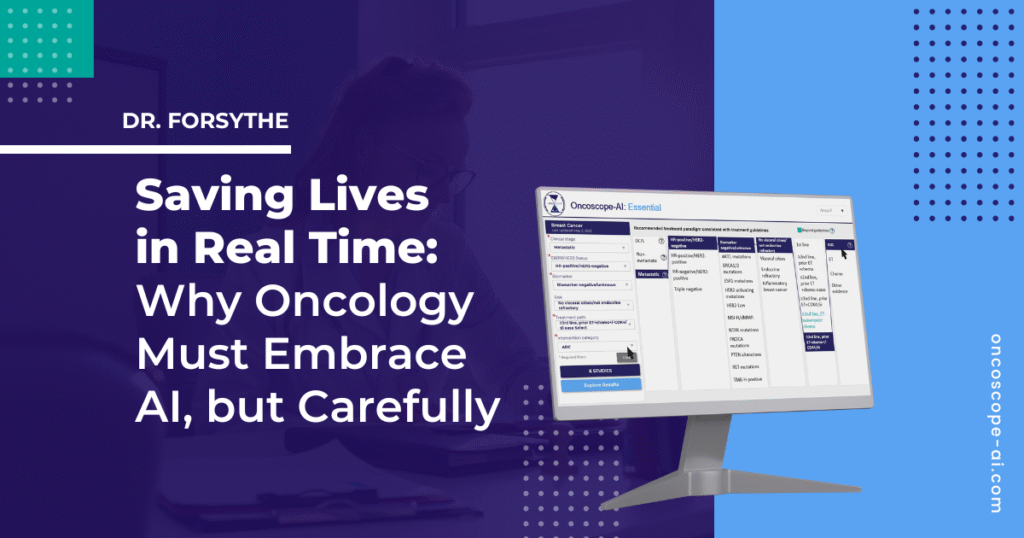
In January, my close friend Susan received devastating news: after six long years of navigating chemotherapy, surgery, radiation, and a targeted therapy that had finally given her back her quality of life, her breast cancer had returned, this time to her liver. She was terrified, not just of the disease, but of what might come next. “I just don’t want to go through chemo again,” she said, fighting back tears. “Is there anything new?” Her oncologist, she said, was excellent. But like so many today, he was overwhelmed. She feared he wouldn’t have time to search for new options that might have emerged in recent months. As a health economist, I’ve spent years sifting through research and data, and I knew that finding up-to-date, reliable information shouldn’t depend on how many hours a doctor can spare after a crushing workload serving patients in the clinic. The mountain of data is overwhelming to even the most dedicated physician trying to keep up. In 2024 alone, over 4,800 papers were published describing breast cancer clinical trials. In the first three months of 2025, another 860 have already appeared. Meanwhile, headlines everywhere tout artificial intelligence (AI) as a revolutionary force in healthcare. But wise physicians and patients alike know the truth: while AI’s potential is enormous, its safe and meaningful application demands careful human oversight, clinical rigor, and a deep understanding of what is at stake. That’s why I turned to a new kind of tool—an AI system specifically designed for medicine, rigorously vetted by human experts, and built not just to gather data, but to curate it, critically evaluate it, and prioritize clinical relevance. Far beyond your average ChatGPT-style chatbot, the tool was a hybrid system: part artificial intelligence, part human expertise. Behind the scenes, it performed a systematic review of the latest literature, flagged high-quality clinical trials, and filtered out unreliable data, creating a curated, searchable database of real, actionable evidence. Within minutes, this hybrid AI-human platform helped me discover a promising new class of drugs—antibody-drug conjugates or ADCs. These therapies target chemotherapy precisely to cancer cells, sparing healthy tissue and potentially reducing side effects. One ADC had just demonstrated outstanding results in a major clinical trial—results so recent they hadn’t yet made it into official treatment guidelines. Susan shared this information with her oncologist. After reviewing the evidence, he agreed. Today, she is on the new therapy—and planning her next vacation. As Dr. Mehran Habibi, a leading breast cancer surgical oncologist in New York, put it to me recently: “AI can’t replace clinical judgment—but it can support it. The only way physicians will trust these tools is if they know the science behind them has been vetted by humans who understand the stakes.” What’s striking isn’t just the speed with which this information was uncovered, but the fact that it could so easily have been missed, he said. “While oncologists are expected to stay on top of a constantly evolving field, the guidelines they depend on, produced by expert committees, are updated infrequently, and, despite the best of intentions, are not immune to biases or conflicts of interest. Additionally, tools like ChatGPT, while popular, can’t be trusted to provide rigorously sourced, clinically relevant information. They’re prone to consider misinformation and half-truths rampant on the internet, and often present content that is incomplete, outdated, or based on opinion rather than evidence.” ChatGPT and other apps that utilize AI are powerful tools in many fields, but not necessarily for clinical science, which demands the highest rigorous standards to be useful to oncologists, he continued. “We don’t rely on GPS apps that guess which roads exist — we expect accuracy and live updates. We don’t book flights through websites that suggest destinations based on personal blogs instead of real availability. So why would we accept anything less in cancer care?” The future of oncology demands “living guidelines”—dynamic, continuously updated frameworks that reflect the latest discoveries, not just a data-dump collected over the last 12 months. That’s what this new class of AI/human tools can enable. They don’t replace the physician. They equip them. And that’s the real power of this approach: it can free up doctors to spend more time with their patients, not less. AI/human tools can support medical education, help residents prepare for board exams, and enhance shared decision-making by providing clear, visual explanations of treatment paths. Susan’s story has a hopeful turn. But there are countless others who may not be as lucky unless we rethink how we connect patients to the best and latest therapies. The race between cancer and medicine is relentless. It’s time we give our doctors the tools to win it. Not because they make decisions for us, but because they make it easier to find the right ones. Anna Forsythe is the Founder and President of Oncoscope-AI, the first platform to bring together real-time oncology treatment data, clinical guidelines, research publications, and regulatory approvals — all in one place, just like Expedia for cancer care. Available free to oncology professionals worldwide, Oncoscope-AI is redefining how cancer care information is accessed and applied. A clinically trained Doctor of Pharmacy (PharmD), Anna also holds a Master’s in Health Economics and Policy from the University of Birmingham (UK) and an MBA from Columbia University. She previously co-founded Purple Squirrel Economics (acquired by Cytel in 2020) and led Global Value and Access at Eisai Pharmaceuticals, following earlier roles at Novartis and Bayer in clinical research and health economics.